
By Aviation Recruiting | For charter operators, flight departments, and aviation maintenance professionals
The day after NBAA-BACE wrapped in Las Vegas, one of business aviation’s biggest manufacturers made a hiring announcement every operator should read twice.
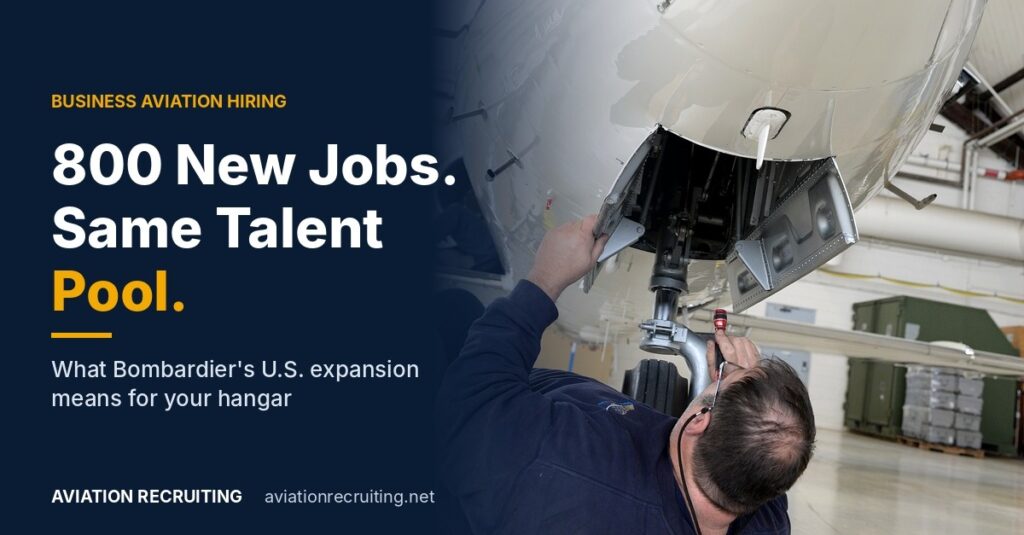
Bombardier said today it plans to hire 800 people across the United States. The company is actively recruiting for 500 positions now and expects to add 300 more through expansion projects, including 150 in Texas. It is backing the plan with an estimated $270 million in the first phase of infrastructure investment.
For the industry, it’s a vote of confidence in U.S. business aviation. For charter operators and flight departments, it’s something else too: another well-funded employer fishing in the same small pool of experienced maintenance talent.
What Bombardier announced
- 800 U.S. hires. About 500 open positions now, plus about 300 more tied to new and expanded facilities.
- A new Fort Wayne service center. A 64,500-square-foot facility at Fort Wayne International Airport is scheduled to open in November. It can hold up to six aircraft and will handle scheduled and unscheduled maintenance, modifications, avionics installations, and AOG support.
- Growth in Texas and Connecticut. Bombardier named a planned expansion in Dallas and a new project in Connecticut.
- A training hub in Wichita. The company’s North American Learning Center in Wichita opened last week.
Bombardier already employs about 3,500 people across more than 20 U.S. states, according to the company. CEO Eric Martel called the American service network “a key pillar of Bombardier’s growth strategy.”
Why it matters if you run a hangar
Most of these jobs are on the service side: maintenance, modifications, avionics, and aircraft-on-ground support. That is exactly where charter operators and corporate flight departments are already struggling to hire.
The numbers were tight before this announcement:
- Business aviation alone needs 69,000 new maintenance technicians worldwide by 2034, part of a total need for 102,000 new business aviation professionals, according to CAE projections cited by GlobalAir.
- North America will need 125,000 new maintenance technicians over the next 20 years, according to Boeing’s 2026 Pilot and Technician Outlook.
- The U.S. is short roughly 9,100 certificated mechanics this year, according to the ATEC and Oliver Wyman 2026 Pipeline Report, even after a record year of new certificates.
OEM service centers can offer things smaller operators often can’t match on paper: structured pay scales, factory training, a clear career ladder, and the stability of a large company. When a new service center opens nearby, experienced A&Ps, inspectors, and avionics technicians in that market start getting calls.
There’s a cost to customers, too. GlobalAir reported in September that a technician shortage can push up labor rates, stretch inspection scheduling and turnaround times, and keep aircraft out of service longer. For a charter operator, an airplane waiting on maintenance is an airplane that isn’t earning.
The upside for operators
This isn’t all bad news. More OEM service capacity in the Midwest and Texas can mean shorter waits for heavy checks and faster AOG response for Bombardier operators. Factory-trained technicians also don’t stay in one place forever. Over time, OEM training programs add skilled, type-experienced people to the wider market.
The operators who come out ahead will be the ones who plan for the competition instead of reacting to it.
What operators and flight departments should do now
- Know your local market. If you’re near Fort Wayne, Dallas, Wichita, or Connecticut, expect more competition for technicians. Benchmark your pay against current data for your region.
- Talk to your technicians before someone else does. Stay interviews, pay reviews, and a clear training plan cost far less than replacing a senior A&P.
- Sell what a big company can’t. Charter and corporate maintenance offers variety, a close-knit crew, direct work with the flight team, and a voice in how the shop runs. Say so in every posting.
- Be specific about schedule. Spell out rotations, on-call expectations, and overtime up front. Predictability is a real advantage.
- Build a pipeline early. Relationships with A&P schools, apprentices, and military-trained technicians give you candidates before they hit the open market.
- Move fast on good candidates. Experienced technicians often have more than one offer. A slow process loses hires.
What technicians should know
- Your options are growing. OEM service centers, MROs, airlines, charter operators, and flight departments are all hiring. Experienced A&Ps, IAs, and avionics techs have real leverage right now.
- Compare the whole package. Pay matters, but so do schedule, overtime, training, tooling, retirement contributions, and shop culture.
- Think about the work you want. A large service center offers structure and factory training. A charter operator or flight department offers variety and a closer team. Neither is wrong. Pick the fit.
- Keep your records ready. Current certificates, training records, and a clear summary of type experience help you move quickly when the right role opens.
The bottom line
Bombardier’s 800 U.S. jobs are a strong sign of confidence in business aviation. They also raise the stakes for every operator trying to hire and keep good maintenance people. The talent pool isn’t getting bigger overnight. The operators who know their market, take care of the people they have, and move quickly on good candidates will keep their airplanes on the line.
Need an A&P, IA, avionics technician, or director of maintenance, or looking for your next role? Aviation Recruiting connects charter operators and corporate flight departments with experienced technicians, pilots, and aviation professionals across the country. Contact us today and let’s talk about your next hire or your next move.
