
By Aviation Recruiting | For charter operators, flight departments, and experienced pilots
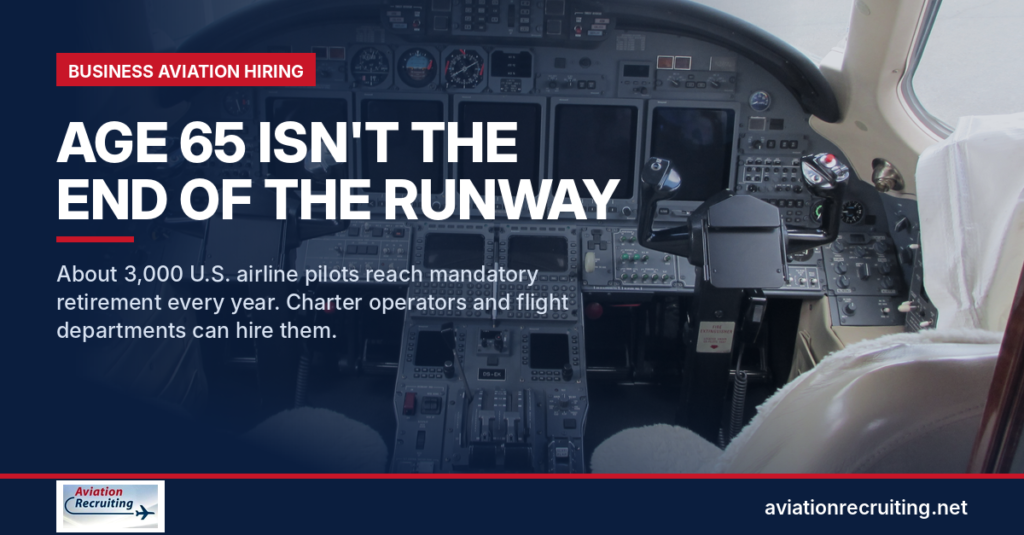
SEO title: Hiring Retired Airline Captains: The Age 65 Talent Pool for Charter and Corporate Flight Departments Meta description: About 3,000 U.S. airline pilots reach mandatory retirement age every year. Here’s why business aviation can hire them, and how to do it well. Excerpt: Every year, about 3,000 U.S. airline pilots reach age 65 and must leave the Part 121 flight deck. Efforts to raise that limit have stalled, but Part 91 and Part 135 flying doesn’t have the same cap. For charter operators and corporate flight departments, these veteran captains may be the most experienced talent pool in aviation. Here’s what operators and pilots should know. Suggested slug: /age-65-retired-airline-captains-business-aviation-hiring
Every year, thousands of the most experienced pilots in the country fly their last airline trip. They don’t leave because they want to, or because they can’t fly. They leave because the calendar says so.
For U.S. airlines, the mandatory retirement age is 65. For charter operators and corporate flight departments, that rule creates one of the most overlooked hiring opportunities in aviation.
1. About 3,000 airline pilots hit 65 every year
A Government Accountability Office report released this spring put numbers on it. Citing data from the Air Line Pilots Association (ALPA), GAO found that about 3,000 currently employed airline pilots are expected to reach age 65 each year from 2025 through 2029.
The longer view is just as striking. Of the roughly 158,000 qualified airline pilots GAO counted in 2024, more than 90,000 will reach 65 within the next 20 years.
These are captains with decades of experience, thousands of hours in multi-crew jets, and years of airline training and checking behind them.
2. The push to raise the limit to 67 has stalled
The age-65 limit has been under pressure for years. The House voted to raise it to 67 as part of its FAA reauthorization bill, but the provision was dropped from the final law Congress passed in 2024. The Let Experienced Pilots Fly Act, which would raise the age to 67, has been introduced again in both the House and Senate this Congress and has not become law.
The international picture hasn’t helped. In October 2025, the 42nd ICAO Assembly turned down an IATA proposal to raise the global pilot age limit beyond 65. ALPA, which opposes raising the age, called the idea “a solution in search of a problem.”
For now, 65 remains the line for U.S. airline pilots, and the retirements keep coming.
3. Business aviation plays by different rules
The age-65 rule applies to pilots flying for Part 121 air carriers. FAA regulations don’t impose that same cap on Part 91 corporate flying or Part 135 charter operations. Pilots who still hold the required certificates and medical can keep flying, subject to each operator’s own policies and its insurer’s requirements.
Even supporters of raising the airline age have pointed this out. When a House committee debated the issue in 2023, Rep. Troy Nehls noted that retiring pilots “can still fly corporate and charter jets beyond the age of 65.”
That’s an important distinction for operators. The pilots the airlines are required to let go are pilots you are allowed to hire.
4. What veteran captains bring to your operation
- Judgment you can’t train quickly. Thousands of hours of command experience, weather decisions, and abnormal procedures.
- A culture of standards. Years of airline checkrides, CRM training, and SOP discipline.
- Mentorship. A seasoned captain paired with a newer first officer accelerates the experience curve. That matters when, as GAO and others have noted, much of the industry’s experience is approaching retirement at the same time.
- Stability. Many retiring captains aren’t climbing a career ladder. They want to keep flying on a schedule that works for them, which can mean less turnover pressure for you.
- Flexibility. Some want full-time roles. Many prefer contract, part-time, or rotation work, which can help operators cover peak demand like the holiday charter rush.
5. What to plan for when you hire one
Hiring a retired airline captain isn’t the same as hiring any other pilot. Plan for:
- Insurance. Talk to your aviation insurance broker before you make an offer. Underwriters may have their own requirements for older pilots, such as added training or experience minimums.
- International trips. ICAO age standards can still apply to commercial flights in other countries’ airspace. If your operation flies charter internationally, know how that affects crew pairing.
- Medical currency. Pilots over 40 face more frequent FAA medical exams. Build that into scheduling and backup planning.
- Type ratings and training. An airline captain may not hold a type rating in your aircraft. Budget time and cost for initial training, plus your Part 135 checks if you’re a charter operator.
- A different job. Airline flying comes with dispatch, crew scheduling, and ground handling built in. In charter and corporate flying, the crew often handles trip planning, FBO coordination, catering, and passenger service. Some pilots love that. Others don’t. Ask.
- Fair hiring practices. Hire on qualifications, not age. Federal law generally protects workers 40 and over from age discrimination, so keep your screening focused on certificates, experience, training, and fit.
6. For pilots approaching 65
If your airline retirement date is on the calendar, you have options.
- Start early. Begin conversations with operators a year or more before your retirement date, not after.
- Know what you want. Full-time, part-time, contract, or rotation. Light, midsize, or large-cabin jets. A home base you’ll be happy with.
- Be ready for a different pace. Business aviation is customer-facing. Flexibility, service, and teamwork with a small crew matter as much as stick-and-rudder skills.
- Keep your records ready. Current medical, certificates, logbook totals, training records, and a clear summary of type experience help you move quickly when the right role opens.
The bottom line
Age 65 ends an airline career. It doesn’t have to end a flying career. With roughly 3,000 airline pilots reaching mandatory retirement every year and no change to the rule in sight, charter operators and corporate flight departments have access to a steady stream of some of the most experienced pilots in the world. The operators who build a plan to recruit, insure, and train them will gain experience their competitors can’t easily match.
Looking for experienced captains, or planning your next chapter after the airlines? Aviation Recruiting connects charter operators and corporate flight departments with experienced pilots, technicians, and aviation professionals across the country. Contact us today and let’s talk about your next move.
