By Aviation Recruiting | For charter operators, flight departments, and aviation professionals
Earlier this fall, we wrote that airline hiring had cooled and business aviation had a rare opening to build its crews. That was true. It’s also starting to change.
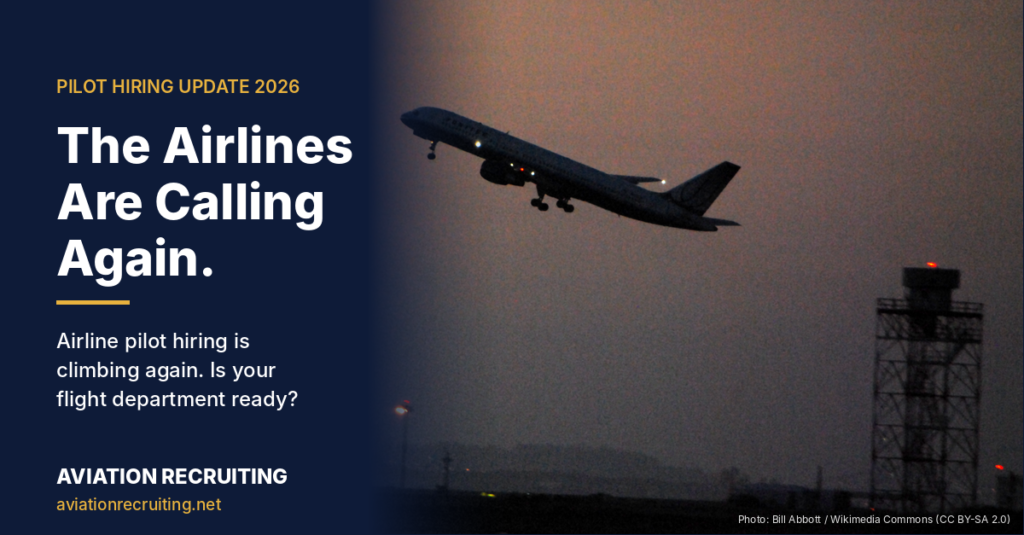
New data shows major airline pilot hiring picked back up in late summer, and the airlines are telling the industry to expect more in 2027. For charter operators and corporate flight departments, the message is simple: the window is still open, but it won’t stay open forever.
Here’s what’s happening, and what it means for both sides of the hiring table.
1. August was the busiest hiring month since March
According to the Future and Active Pilots Alliance (FAPA), U.S. major airlines hired 648 pilots in August 2026. That’s the most since March and more than double May’s total of 306.
Year-to-date, the majors have hired 4,511 pilots through August. That already matches all of 2025 (4,509) and is closing in on 2024 (4,834), with four months still to go.
It’s still nowhere near the record years of 2022 and 2023, when the majors hired more than 12,000 pilots each year. But the direction has changed.
2. The airlines are pointing to 2027
At the OBAP Industry Briefing this summer, airlines shared their plans, as reported by ATP Flight School:
- Delta plans to hire 2,000 pilots by the end of 2026 and expects to keep hiring at a “robust” pace through the first quarter of 2027.
- United plans to hire 900 more pilots in the rest of 2026, bringing its total for the year to about 1,500.
- American expects additional retirements in 2027, which means more openings.
ATP also reported that airline hiring of its graduates is up nearly 40% this year. The school’s vice president of marketing, Michael Arnold, said “all signs point to an even stronger year in 2027.”
3. Retirements keep the pressure on
The long-term driver hasn’t gone anywhere. A U.S. Government Accountability Office (GAO) report released this spring, citing ALPA data, found that about 3,000 airline pilots per year will reach the mandatory retirement age of 65 from 2025 through 2029. Over the next 20 years, more than half of today’s certified commercial pilots will reach that age.
The same report found that average first-year pay for regional first officers rose from about $52 an hour in 2021 to about $93 an hour in 2024, adjusted for inflation. The airlines have raised the bar on pay, and they’ll use it again.
4. Why business aviation feels it next
FAPA’s Tim Genc has described the major airlines as “the first car at the stoplight.” When the majors start moving, the regionals follow, and then everyone else feels it.
For business aviation, that usually means:
- Experienced captains get the call first. As Aero Crew News noted this month, airlines especially target experienced pilots in their 30s and 40s with pay, defined career paths, and predictable schedules.
- Pilots who joined “for now” reconsider. Pilots who came to Part 135 or Part 91 during the slowdown may reopen their airline applications.
- Training investments walk out the door. Every type rating you paid for goes with the pilot who leaves.
- Leadership gaps get exposed. When a senior captain or chief pilot leaves, there may be no obvious successor. As one industry recruiter put it on GlobalAir this summer, “Retirement doesn’t create succession problems—it exposes them.”
5. What operators and flight departments should do now
- Finish your hiring before the next airline push. If you have open or soon-to-be-open seats, fill them this fall while the candidate pool is still deep.
- Have the retention conversation before the airlines do. Talk with your pilots about what they want in the next two to three years. A pilot who feels heard is far less likely to take the first airline call.
- Compete on what the airlines can’t offer. Varied missions, smaller crews, relationships with passengers, and a voice in the operation are real advantages. Make sure your people know you value them.
- Be clear on schedule and pay. Airlines win on predictability. Spell out your rotation, on-call expectations, and time off, and benchmark your total compensation against the market.
- Build your bench. Identify who could step into chief pilot, director of aviation, or lead captain roles, and start preparing them now.
6. What pilots should consider
- Know your timeline. If the airlines are your goal, 2027 may bring more opportunities. If business aviation is your career, this is a strong time to lock in a quality seat.
- Compare the whole picture. Look at schedule, base, quality of life, training, and long-term earning potential, not just the first-year number.
- Weigh seniority honestly. An airline seat means starting over at the bottom of a seniority list. A business aviation seat can mean type ratings, leadership roles, and a schedule you can plan around.
- Keep your records current. Certificates, medical, training records, and an accurate logbook help you move quickly when the right role opens.
The bottom line
The airline slowdown gave business aviation its best hiring window in years. The August numbers and the airlines’ 2027 outlook suggest that window is starting to close. Operators who hire and retain well this fall will be ready when the airlines come calling. Those who wait may find themselves competing for pilots all over again.
Workforce will be one of the biggest conversations at NBAA-BACE in Las Vegas next week, October 20–22.
Need to fill a cockpit seat before the airlines’ next push, or weighing your own next move? Aviation Recruiting connects charter operators and corporate flight departments with experienced pilots, technicians, and aviation professionals across the country. Contact us today and let’s talk.
