By Aviation Recruiting | For charter operators, flight departments, and aviation professionals
SEO title: Aviation Needs 2.44 Million New Workers by 2045: What It Means for Business Aviation Hiring Meta description: Airbus says aviation must hire 660,000 pilots and 730,000 technicians by 2045, and that’s before counting business aviation. What operators and job seekers should do now. Excerpt: Suggested slug: /aviation-workforce-forecast-2045-business-aviation-hiring
Every year, the big manufacturers publish their long-range forecasts. This week, Airbus put a number on the people side of the industry, and it’s a big one.
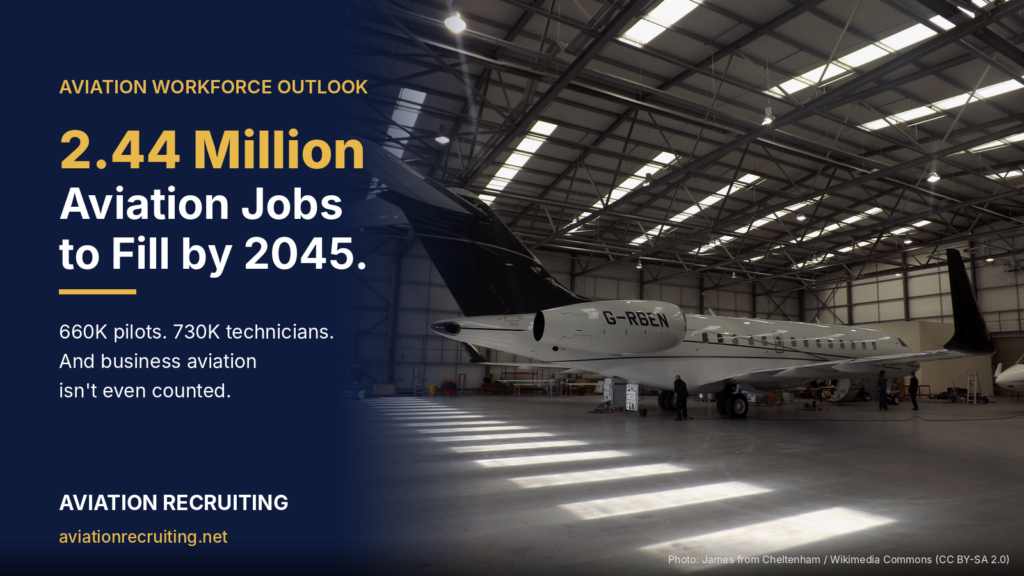
On October 14, Airbus released its 2026–2045 Global Services Forecast. Alongside its outlook for aircraft and maintenance spending, it said the industry will need more than 2.44 million additional skilled people over the next two decades. In its words, the industry “must intensify efforts to attract and train new talent.”
Here’s what the forecasts say, what they leave out, and what it means for anyone hiring, or hoping to be hired, in business aviation.
1. The headline numbers
According to Airbus, the industry will need, between 2026 and 2045:
- 730,000 maintenance technicians
- 660,000 pilots
- 1.05 million cabin crew
The reason is simple: the world’s fleet is growing. Airbus expects the global commercial fleet to roughly double to more than 45,550 aircraft by 2045, and every one of those aircraft needs people to fly it, maintain it, and serve its passengers.
What it means: This isn’t a one-year spike. It’s two decades of steady demand for the same skilled people charter operators and flight departments depend on.
2. Boeing’s numbers say the same thing
Boeing reached nearly the same conclusion in its 2026 Pilot and Technician Outlook, released in July. Boeing forecasts demand for 674,000 commercial pilots, 728,000 maintenance technicians, and 1,023,000 cabin crew through 2045.
For North America specifically, Boeing projects a need for:
- 122,000 pilots
- 125,000 maintenance technicians
- 191,000 cabin crew
What it means: When the two largest aircraft manufacturers, working independently, land within a few percent of each other, the trend is hard to ignore. North America alone needs more technicians than pilots.
3. The forecasts don’t count business aviation
This is the part charter operators should pay close attention to. Boeing’s outlook specifically excludes business aviation and civil helicopters. It only counts the commercial airline side.
That means every corporate flight department, Part 135 charter operator, fractional program, and MRO shop that supports them will need its own pilots and technicians, on top of those totals, and they’ll be hiring from the same pool of people.
What it means: Business aviation isn’t just competing with other charter operators for talent. It’s competing with the airlines and their fast-growing fleets for the same certificated pilots and A&Ps.
4. The maintenance gap is already here
You don’t have to wait 20 years to see the shortage. It’s showing up at the schools right now.
An NPR report from July followed the 2026 graduating class at the Pittsburgh Institute of Aeronautics. Nearly half of the graduates had jobs before they finished school, and 47 of 54 maintenance students passed the FAA A&P exam on their first try. The school, founded in 1929, now has a waitlist.
The pay reflects the demand. According to federal data cited in the report, the median aviation technician salary was $79,140 in 2024, about $30,000 above the median for all U.S. jobs.
What it means: The best new A&Ps are being hired before they graduate, often by airlines and large MROs. If your hiring plan is to post a job and wait, you’re already behind.
5. The airlines are already moving
The long-term forecasts match what’s happening this year. As we covered recently, U.S. major airlines had hired 4,511 pilots through August 2026, already matching all of 2025, according to Future and Active Pilot Advisors (FAPA).
What it means: When airlines hire, they often recruit from regional carriers, charter, and corporate flight departments. Long-range demand plus near-term airline hiring adds up to steady pressure on business aviation rosters.
What operators and flight departments should do now
- Plan for the long term, not just the next opening. Build a hiring plan for the next three to five years, including expected retirements, fleet changes, and growth.
- Build pipelines, not just job posts. Relationships with A&P schools, flight schools, and military transition programs give you access to candidates before they hit the open market.
- Invest in the people you have. Training, a clear path to upgrade, predictable schedules, and competitive pay keep good people from taking the airline call.
- Hire for potential. A strong first officer or newer A&P who fits your culture can grow into the role, often faster than you can find a fully experienced replacement.
- Move fast on good candidates. In a tight market, the best pilots and technicians often have more than one offer. A slow hiring process costs you hires.
What pilots and technicians should know
- The long-term outlook is strong. Two decades of forecast demand means skilled aviation professionals have real career security and leverage.
- Business aviation is a real alternative. Charter, fractional, and corporate flying offer variety, aircraft you won’t fly at an airline, and often a better quality of life.
- Maintenance skills travel. A&Ps, avionics technicians, and inspectors are in demand across airlines, MROs, and business aviation, so your options are wide.
- Keep your records ready. Current certificates, medicals, training records, and logbooks let you move quickly when the right opportunity comes along.
The bottom line
The numbers are clear: aviation needs more than 2.44 million new pilots, technicians, and cabin crew over the next 20 years, and that’s before business aviation is counted. The operators who start building their talent pipelines now will be the ones with full rosters while others are turning down trips.
Need help building your team, or looking for your next role? Aviation Recruiting connects charter operators and corporate flight departments with experienced pilots, maintenance technicians, and aviation professionals across the country. Contact us today and let’s talk about your hiring plan.
