By Aviation Recruiting | For MRO providers, aerospace manufacturers, and aviation maintenance professionals
For years, the aviation maintenance conversation has been about one number: how many technicians the industry is short. Last week in Amsterdam, a room full of MRO leaders pointed to a different one.
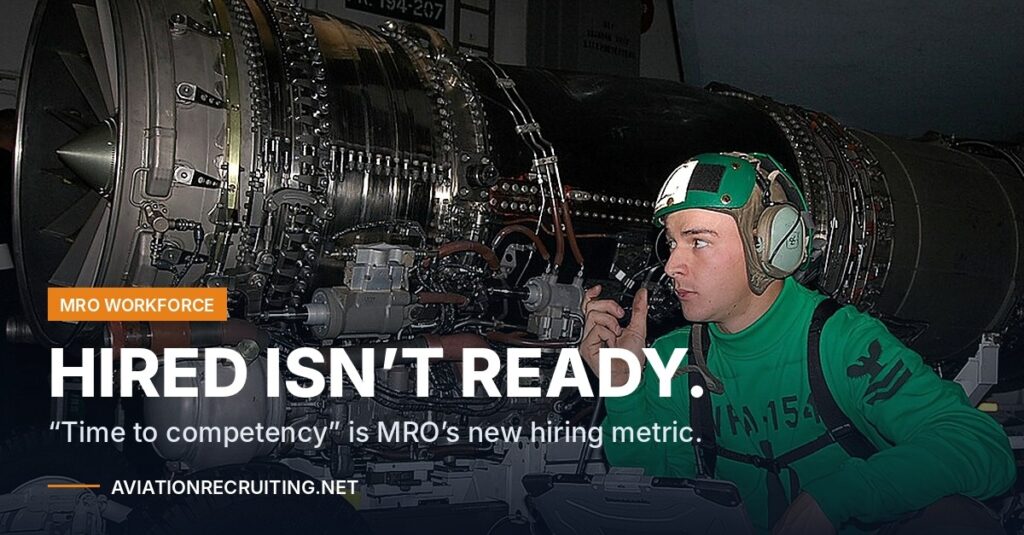
At MRO Europe, an audience poll ranked time to competency as the biggest workforce challenge facing maintenance, repair and overhaul, ahead of skills shortages, recruiting new talent and retention, according to Aviation Week.
In plain terms: hiring someone is not the finish line. The real question is how long it takes before that new hire holds the skills and authorizations to work on an aircraft or engine independently and safely.
“We are racing against time. It is time to competency,” said Kenan Şahan, senior vice president of human resources at Turkish Technic.
Why the clock matters now
The pressure on MRO shops isn’t easing. Airlines and operators are flying older aircraft longer because new deliveries are behind schedule, and older aircraft need more maintenance.
- Maintenance demand is climbing. Boeing projects maintenance hours rising from 310 million to 565 million a year by 2043, according to BCG.
- Shops are already stretched. BCG reports heavy check turnaround times are 45 days longer than before COVID-19, and repair wait times for modern engines have risen 150%.
- Downtime is expensive. Grounded aircraft cost the industry roughly $27 billion a year in lost value, BCG estimates.
- New techs take time to build. Training and certifying a new technician takes two to three years, BCG notes, and becoming proficient across multiple complex aircraft systems takes longer.
Put those together and the math is simple. A shop can win the hiring battle and still lose capacity if new people spend too long waiting to sign off on work. Every month of ramp-up is a month the most experienced technicians spend splitting time between turning wrenches and supervising.
What leading MROs are doing differently
The panel at MRO Europe shared a few practical approaches.
Start before graduation. Turkish Technic works with vocational schools and universities to find candidates early. Its program includes a six-month development process and internships at its maintenance campus. About 55 recruits a year come through that student pipeline, and they need less onboarding time than other candidates for comparable positions.
Henri Werij, dean of aerospace engineering at TU Delft, put it bluntly: “If you just arrive when they graduate, I can tell you that most of them already found a job elsewhere.” He noted that Dutch aerospace engineering graduates are being drawn into the semiconductor industry, which values the same systems thinking.
Make training hands-on. Lufthansa Technical Training said training has to adapt to younger technicians, with more hands-on work, simulators and digital tools, and closer ties between schools and industry.
Cut the non-wrench time. BCG found that roughly half of technician time goes to activities other than hands-on maintenance, such as waiting for parts or searching for documentation. Getting parts, data and tooling ready before work starts helps every technician, but it helps new hires most.
Don’t promote your best techs into the wrong job. Şahan warned that moving highly skilled technicians into management without preparation can cost a shop its technical expertise and produce ineffective managers. Panelists called for clearer career paths on both the technical and leadership sides.
The engineering connection
This isn’t only a hangar issue. The same competition shows up for aerospace engineers, reliability engineers and technical representatives. The industries that compete with aviation for engineering talent, from semiconductors to energy, recruit early and move fast. Aerospace manufacturers and MROs that wait for the résumé to arrive are often too late.
What MRO employers should do now
- Track it. Measure how long it takes a new hire to reach independent sign-off, by role. You can’t shorten a number you don’t know.
- Build a pipeline before you need it. Partner with A&P schools, Part 147 programs, community colleges and military transition programs, and offer internships.
- Hire for the ramp, not just the résumé. A candidate with type, engine or component experience close to your work can cut months off onboarding. Be specific about that experience in job postings.
- Pair new hires with mentors on purpose. Structured mentoring, with time set aside for it, beats hoping knowledge transfers on its own.
- Prepare the work, not just the worker. Staging parts, documents and tooling ahead of time gives new technicians more real hands-on hours.
- Show a clear path. Spell out what it takes to earn each authorization and what the next step looks like, technical or leadership.
What technicians and engineers should know
- Your experience is worth more than ever. Employers are looking for people who can be productive quickly. Type ratings, engine experience, inspection authority and OEM training all shorten the ramp.
- Document everything. Keep certificates, training records and a clear summary of the aircraft, engines and components you’ve worked on. It helps an employer see how fast you’ll be up to speed.
- Ask about training in the interview. How long does it take to get authorizations? Who will mentor you? Is there a defined path? The answers tell you a lot about the shop.
- Students: get in early. Internships and apprenticeships put you in front of employers before graduation, which is when the best offers are being made.
The bottom line
The technician shortage is real, but the MRO leaders in Amsterdam made a sharper point: a hire only adds capacity once that person is ready to work independently. The shops that recruit early, hire for relevant experience and build structured paths to sign-off will turn new hires into productive technicians faster, and keep more aircraft and engines moving.
Hiring A&P technicians, inspectors, engine and avionics specialists, or aerospace engineers, or looking for your next role? Aviation Recruiting connects MRO providers, manufacturers and aviation employers with experienced technical professionals across the country. Contact us today and let’s talk about your next hire or your next move.
