Nov 11, 2026 · @Sharon
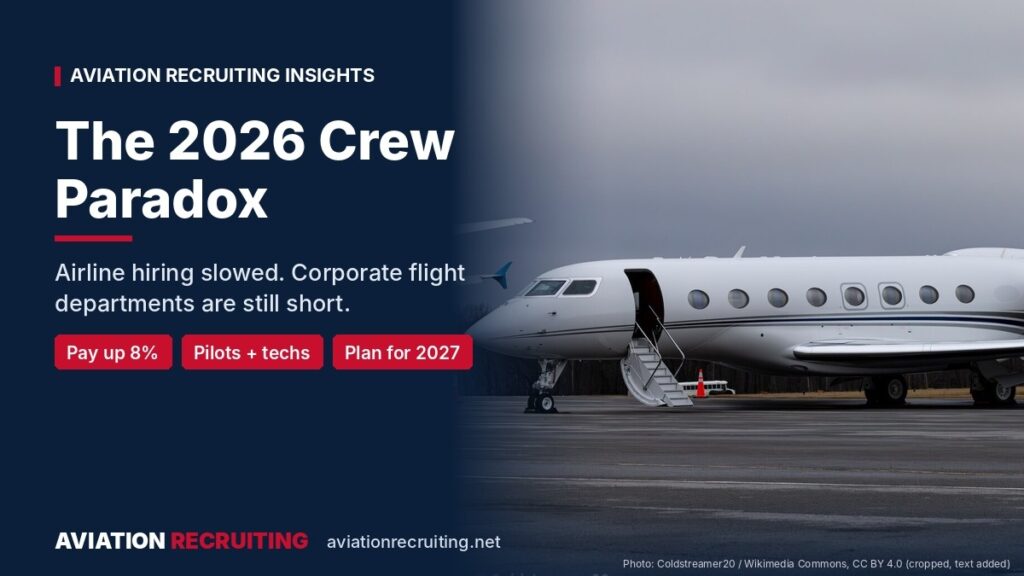
The 2026 Crew Paradox: Airline Hiring Cooled. Your Crew Search Didn’t.
If you run a corporate flight department or charter operation, you’ve probably heard the headline: the airlines have tapped the brakes on pilot hiring. So why is it still so hard to fill your left seat, your right seat, and your hangar?
Because the pilot market didn’t loosen where it matters to you. Here’s what the latest numbers say, and what it means for your next hire.
The airlines slowed down. The talent didn’t come your way.
U.S. major airlines hired more than 13,000 pilots in 2022 and over 12,000 in 2023. Through July 2026, FAPA-tracked majors had hired 3,863, on pace for roughly 8,000 this year (AOPA).
That sounds like relief. It isn’t. The slowdown has mostly hit low-time pilots, who now face a tougher entry market. Experienced business aviation captains in their 30s and 40s are still being courted by airlines offering big pay, clear seniority paths, and predictable schedules (Aero Crew News).
As NBAA’s Joanne Damato put it: “We are all competing for the same pool.”
Pilots are still the #1 pain point
In NBAA’s 2026 Safety Committee workforce study, 53% of operators named pilot roles as the positions most affected by staffing shortages. And 41% expect shortages could make safety conditions worse (AVweb).
In-Flight Crew Connections’ State of the Staffing Industry 2026 report names the real issue: it’s less about supply and more about readiness. There are plenty of applicants. There are far fewer who are ready for the specific demands of business aviation on day one (AIN).
Pay is up 8%, and paying “average” is now a risk
Business aviation compensation rose an estimated 8% in 2026, up from 6% in 2025, according to AirComp Calculator’s analysis released on the eve of NBAA-BACE in October. That’s more than double the 3.4% rise across the broader civilian workforce. Northeast salaries run 10–15% above the national average, and some West Coast markets pay premiums near 30% (AVweb).
“If you’re paying at the 50th percentile of what the business aviation market is paying, you’re accepting risk,” said AirComp founder Chris Broyhill.
But money alone won’t hold a crew. In Aviation Personnel International’s survey of Part 91 leaders, 74% said compensation and benefits matter for retention, and 54% pointed to schedule predictability and time off.
The hangar is the quiet emergency
Pilots get the headlines. Technicians may be the bigger long-term problem.
The median business aviation technician is about 54 years old. The Bureau of Labor Statistics projects 13,100 openings a year for aircraft and avionics technicians through 2035, many from retirements (Aero Crew News). Maintenance labor rates are climbing 5.5–6% a year, about double the pre-pandemic pace (Aviation Index).
When a senior A&P retires, decades of type-specific knowledge walks out the door with them.
Even the system around you is short-staffed
The U.S. has about 6% fewer air traffic controllers than a decade ago while flights have grown about 10%. The FAA hired a record 2,235 controller trainees in fiscal 2026, but certification takes years (Fortune). Expect more delays and tighter schedules, which put even more pressure on crew duty time and planning.
What smart flight departments are doing now
- Benchmark pay against business aviation, not last year’s budget. If your offer sits at the median, you’re likely losing finalists.
- Sell the schedule. Predictable rotations and real time off are now as powerful as a raise.
- Vet for readiness, not just hours. Verified flight time, type experience, operational fit, and safety-culture alignment separate a good hire from an expensive one.
- Plan maintenance succession today. Pair senior technicians with rising talent before retirements force the issue.
- Build a bench before you need it. The fastest hire is the one already vetted when a seat opens.
How Aviation Recruiting helps
At Aviation Recruiting, we specialize in flight crew and aviation talent for corporate flight departments, charter operators, and private aviation. Our vetting goes deep: verified flight time, operational fit, and safety-culture alignment. And our pre-built candidate pipeline means you’re not starting from zero when a seat opens.
Short a pilot, technician, or flight department leader? Let’s talk. Visit aviationrecruiting.net to start your search today.
