
By Aviation Recruiting | For charter operators, flight departments, and aviation maintenance professionals
Ask a charter operator or director of aviation which position keeps them up at night, and more often than not the answer isn’t a pilot. It’s the person who signs off the airplane before the pilot ever sees it.
New industry data released in the past few weeks shows why. The training pipeline for aviation maintenance technicians is stronger than it has been in decades, and the shortage is still getting worse.
1. The pipeline just set a record
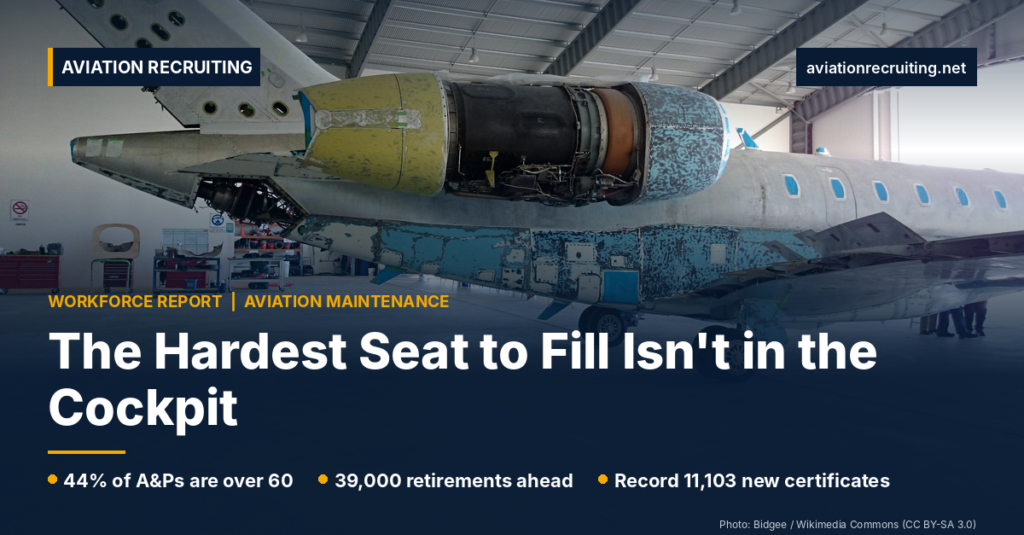
The Aviation Technician Education Council (ATEC) and Oliver Wyman released their 2026 Pipeline Report last month. The headline is good news: the FAA issued 11,103 new mechanic certificates in 2025, up 23.2% from the year before and the highest total on record.
Most of that growth came from schools. FAA-certificated maintenance schools produced 7,496 of those new mechanics, a 27% increase, and enrollment rose 13.5% to 27,740 students. Certificates earned through on-the-job experience and apprenticeships grew 21%, and military-experience certificates rose 5% to 1,375.
2. Retirements are still winning
Here’s the problem. According to the same report, 44% of certificated mechanics are over age 60, and about 39,000 retirements are expected over the next decade.
ATEC and Oliver Wyman project a shortfall of roughly 9,100 certificated mechanics this year, growing to about 20,000, or 12% of demand, by 2030. Boeing’s 2026 Pilot and Technician Outlook adds the long view: North America will need 125,000 new maintenance technicians over the next 20 years.
A record year of new certificates narrows the gap. It doesn’t close it.
3. Training seats are sitting empty
You might expect schools to be turning students away. They aren’t. The Pipeline Report found that only 62% of available A&P program seats were filled, and it named insufficient funding for facilities, tools, and equipment as the biggest obstacle to growing programs.
Graduates aren’t waiting long for work. NPR reported in July that nearly half of one Pittsburgh school’s 2026 class had a job lined up before graduation, with more than 15 employers hiring from it. The U.S. Bureau of Labor Statistics puts the median pay for aircraft mechanics and technicians at about $79,000, roughly $30,000 above the national median wage, and that’s without a four-year degree.
4. Why business aviation feels it first
Every segment of aviation is short on technicians. Charter operators and corporate flight departments feel it in a few specific ways:
- Small teams, no backup. Many flight departments have one to three technicians. When one leaves, a third or more of the maintenance capability walks out the door.
- Type experience is hard to replace. A senior A&P with years on a specific Citation, Challenger, or Gulfstream carries knowledge no new hire has yet.
- The competition is bigger. Airlines and large MROs are recruiting from the same small pool, often with structured pay scales, signing bonuses, and training programs.
- More flying means more maintenance. Business aviation activity has stayed strong through 2026, and every additional flight hour adds to the inspection and maintenance workload.
5. What operators and flight departments should do now
- Start technician searches early. Waiting until someone gives notice almost guarantees a gap. Build a candidate pipeline before you need it.
- Grow your own. Partner with a local A&P school, offer internships, or sponsor an apprentice working toward certification. The 21% jump in experience-based certificates shows this path is working.
- Look at military-trained technicians. Veterans bring discipline, documentation habits, and hands-on experience. Many need only a clear path to their civilian certificate.
- Protect what you have. Pay reviews, schedule predictability, tooling, training budgets, and recognition keep senior technicians from taking the next recruiter’s call.
- Capture knowledge before it retires. Pair senior technicians with newer ones now. Mentorship is the fastest way to transfer type-specific know-how.
- Sell the role, not just the job. Technicians want to know about the aircraft, the hangar, the on-call expectations, and where the job leads. Say it clearly in every posting.
6. What technicians should know
- Your leverage is real. Experienced A&Ps, especially with business jet type experience or an IA, are among the most sought-after people in aviation right now.
- Compare the whole package. Pay matters, but so do schedule, overtime expectations, training, tooling, retirement contributions, and the culture of the shop.
- Consider business aviation. Charter and corporate maintenance offers variety, close relationships with flight crews, and a direct line of sight to the people you keep safe.
- Keep your records ready. Current certificates, training records, and a clear summary of type experience help you move quickly when the right role opens.
The bottom line
The industry is producing more new mechanics than ever, and it still isn’t enough to replace the experience heading into retirement. For charter operators and flight departments, the maintenance seat is now the hardest one to fill. The operators who plan for it now, by recruiting early, growing their own talent, and keeping the people they have, will be the ones whose airplanes stay on the line.
Workforce will be one of the biggest conversations at NBAA-BACE in Las Vegas, October 20–22.
Need an A&P, IA, or director of maintenance, or looking for your next maintenance role? Aviation Recruiting connects charter operators and corporate flight departments with experienced technicians, pilots, and aviation professionals across the country. Contact us today and let’s talk about your next move.
