By Aviation Recruiting | For charter operators, flight departments, and aviation professionals
For the past few years, the story in aviation hiring was simple: airlines hired everyone they could, and business aviation struggled to hold on to its people. In fall 2026, that story has changed.
Airline hiring has cooled sharply. Business aviation flying has not. For charter operators and corporate flight departments, that creates an opening that hasn’t existed in years. For pilots and mechanics, it changes where the best opportunities are.
Here are the five trends we’re watching, and what they mean for both sides of the hiring table.
1. Major airline pilot hiring has slowed dramatically
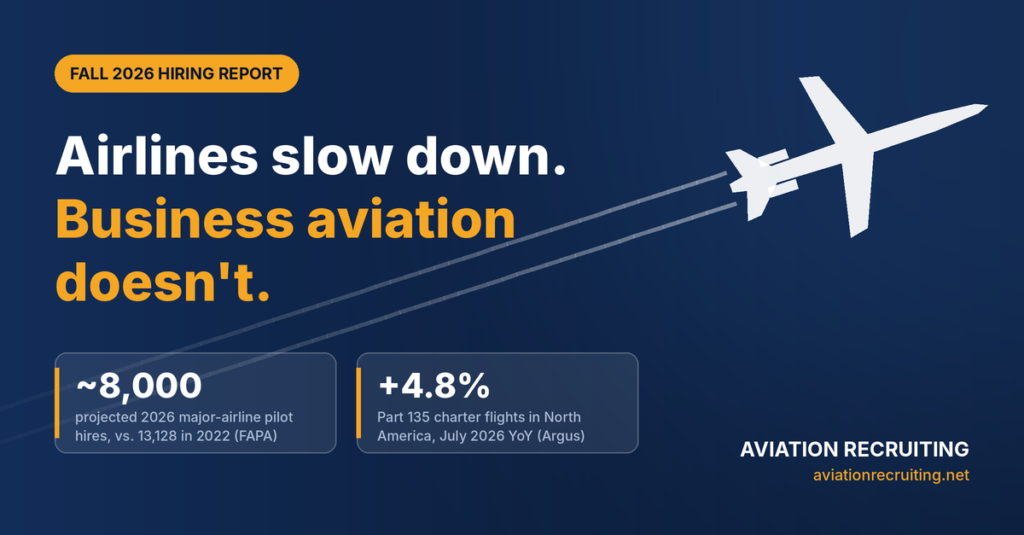
According to Future and Active Pilot Advisors (FAPA) data reported by AOPA, U.S. major airlines hired 13,128 pilots in 2022 and 12,196 in 2023. Through July 2026, they had hired 3,863, with roughly 8,000 projected for the full year.
The slowdown cascades down the ladder. When fewer captains move up at the majors, regional airlines have fewer openings to fill, and many regionals are now asking for 50 to 100 hours of multi-engine time instead of the regulatory minimum.
What it means: More experienced, well-qualified pilots are open to Part 135 and Part 91 roles than at any point since before the pandemic. Pilots who once saw charter flying as a short stop on the way to the airlines are now looking at it as a career.
2. Business aviation flying keeps climbing
While airline hiring cooled, business aviation stayed busy. Argus TRAQPak data showed global business aviation flight activity up 5.6% year over year in July 2026. In North America, activity rose 4.3%, led by fractional operators (up 10.0%), with Part 135 charter up 4.8% and Part 91 up 1.4%.
The busiest stretch of the year is still ahead. Holiday charter demand typically peaks between December 26 and 28, when daily flight volume runs about double that of early December.
What it means: Operators heading into Q4 without a full crew roster are already behind. More flying means more crew days, more duty-time pressure, and less margin when someone leaves.
3. Long-term demand hasn’t changed
Short-term airline hiring cycles don’t change the long-term math. Boeing’s 2026 Pilot and Technician Outlook projects the commercial aviation industry will need 674,000 new pilots and 728,000 new maintenance technicians worldwide over the next 20 years, including 122,000 pilots and 125,000 technicians in North America.
Those numbers don’t include business aviation at all. Every one of those future airline hires is a person business aviation will compete for, too.
What it means: Today’s softer airline market is a window, not a permanent shift. Operators that hire and retain well now will be in a stronger position when airline hiring picks back up.
4. Maintenance technicians remain the tightest bottleneck
If pilots are easier to find this year, technicians are not. As Aero Crew News reported this month, the median age of business aviation technicians is about 54, and the U.S. Bureau of Labor Statistics projects roughly 13,100 openings for aircraft technicians each year through 2035, driven largely by retirements.
Experience can’t be replaced overnight. Losing a senior A&P means losing years of type-specific knowledge, along with the person best positioned to train the next generation.
What it means: For many operators, the maintenance department is now the harder seat to fill. Retaining senior technicians and building a mentoring path for newer ones is as important as recruiting.
5. Pay matters, but quality of life is closing the deal
Professional Pilot magazine’s 2026 Salary Survey found business aviation pilot salaries rose about 3% this year. Pay is still essential, but the candidates we talk to are weighing the whole package: schedule predictability, reliable days off, benefits, retirement contributions, training, and a clear path forward.
What it means: The operators winning candidates are the ones who can clearly explain what life in the job looks like, not just what it pays.
What operators and flight departments should do now
- Hire while the pool is deep. Experienced pilots are more available than they have been in years. Don’t wait until a vacancy becomes an emergency.
- Lead with schedule and stability. Be specific about rotations, on-call expectations, and time off. Clarity attracts the right candidates and filters out the wrong ones.
- Treat maintenance staffing as a priority. Start technician searches early, and invest in keeping the experienced people you already have.
- Plan for the next airline upturn. Strong onboarding, fair pay reviews, and a real career path keep good people when the airlines start calling again.
What pilots and technicians should do now
- Look seriously at Part 135 and Part 91. Charter, fractional, and corporate flying offer real careers, not just hour building.
- Know what you want. Be clear about schedule, base, and aircraft preferences so a recruiter can match you with the right fit.
- Keep your records ready. Current certificates, medical, training records, and an accurate logbook help you move quickly when the right role opens.
- Mechanics, know your value. Experienced A&Ps, especially with business jet type experience, are among the most in-demand people in the industry.
The bottom line
The airline hiring slowdown has shifted the balance in business aviation’s favor, at least for now. Operators who move decisively this fall can strengthen their crews for years. Pilots and technicians who look beyond the airlines may find the best opportunity of their careers.
Business aviation’s leaders will gather at NBAA-BACE in Las Vegas, October 20–22, and workforce will be one of the conversations everyone is having.
Need to fill a cockpit or hangar seat, or looking for your next role? Aviation Recruiting connects charter operators and corporate flight departments with experienced pilots, technicians, and aviation professionals across the country. Contact us today and let’s talk about your next move.
