
Article
Corporate and business aviation is entering the end of 2026 with strong demand and a familiar problem: not enough qualified people to fly, maintain and support the aircraft.
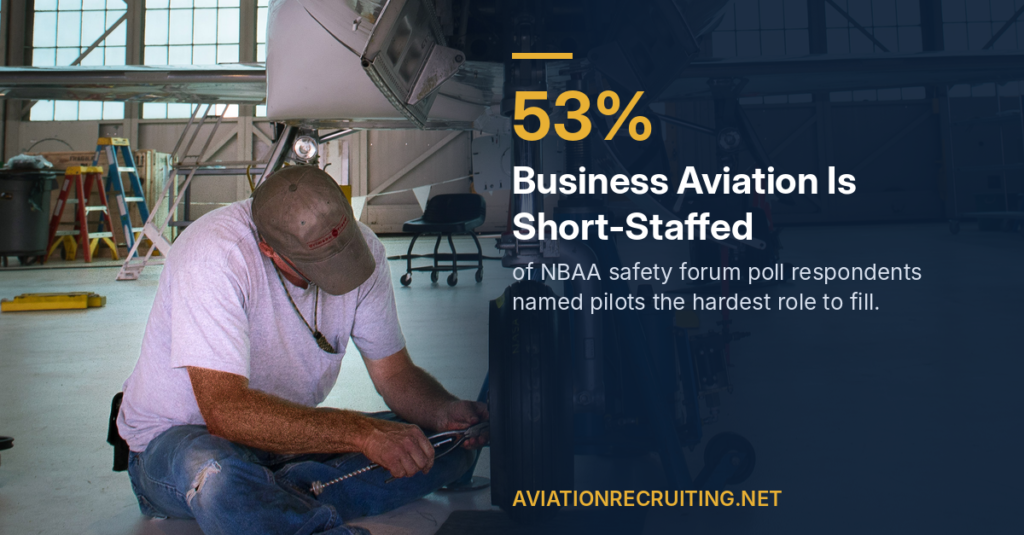
Pilots remain the hardest hire. In an NBAA Safety Committee audience poll, 53% of respondents said pilots are the role hit hardest by shortages, followed by maintenance at 35% and safety management at 12%. Respondents pointed to competition with the airlines as a likely driver. A caveat: the poll was informal and was presented at the 2024 NBAA-BACE safety forum, so treat it as a snapshot of operator sentiment rather than a scientific measure. On safety, 62% reported no increase in incidents or near-misses in the past year, but 41% expect shortages could make conditions worse (AVweb, March 2026).
Pay is rising, but it is not the whole answer. An AirComp Calculator analysis estimates U.S. business aviation pay rose 8% in 2026, up from 6% in 2025 and more than double the 3.4% growth across the broader civilian workforce. Northeast salaries typically run 10% to 15% above the national average, and some West Coast markets carry premiums approaching 30%. In a separate Aviation Personnel International survey of Part 91 flight department leaders, 45% named compensation and benefits a top workforce concern, while recruiting qualified personnel and scheduling each came in at 39%. API’s CEO noted that “a raise isn’t always the answer”: 54% of respondents cited schedule predictability and time off as important for retention (AVweb, Oct. 20, 2026). That survey drew only 75 responses from a nonrandom sample, so it is directional.
The gap spans every role in the department. Boeing’s 2026 Pilot and Technician Outlook projects North America will need 122,000 new pilots, 125,000 maintenance technicians and 191,000 cabin crew over 20 years, a combined 438,000 workers. Roughly two-thirds of that demand comes from retirement and attrition rather than fleet growth, which is why industry observers describe the shortage as structural rather than cyclical. Operators are already adapting: in the NBAA poll, 16% reported outsourcing certain operations and 9% were bringing on temporary staff (Avi-Go, Aug. 31, 2026).
What it means for flight departments and charter operators.
- Retention is as important as recruiting. Scheduling, predictable time off and career paths matter alongside pay.
- Plan for the whole department. Pilots, technicians, schedulers, dispatch and cabin crew often compete for the same limited pool.
- Widen the funnel early. Military, mid-career and collegiate pipelines (NBAA’s Military Connect and Collegiate Connect programs) are part of the answer.
- Benchmark pay by market. Aircraft type and location move the numbers significantly.
At Aviation Recruiting, we help corporate flight departments and charter operators find and keep the people they need. If your team is hiring, we would like to help.
